
Stage Board Packing in Our Factory: Modular Stage Boards, Aluminium Frames, Locks and Stage Legs
Meta description: A real factory look at stage board packing for modular stage boards, including warehouse stock, anti-slip stage panels, 6061-T6 aluminium stage frames, side locks, adjustable stage legs and support accessories.
Modular stage boards may look simple from the outside, but a reliable stage system depends on many details working together. The surface panel, aluminium stage frame, side locks, stage legs, support rods and stage board packing process all affect how fast the stage can be installed and how stable it feels on site.
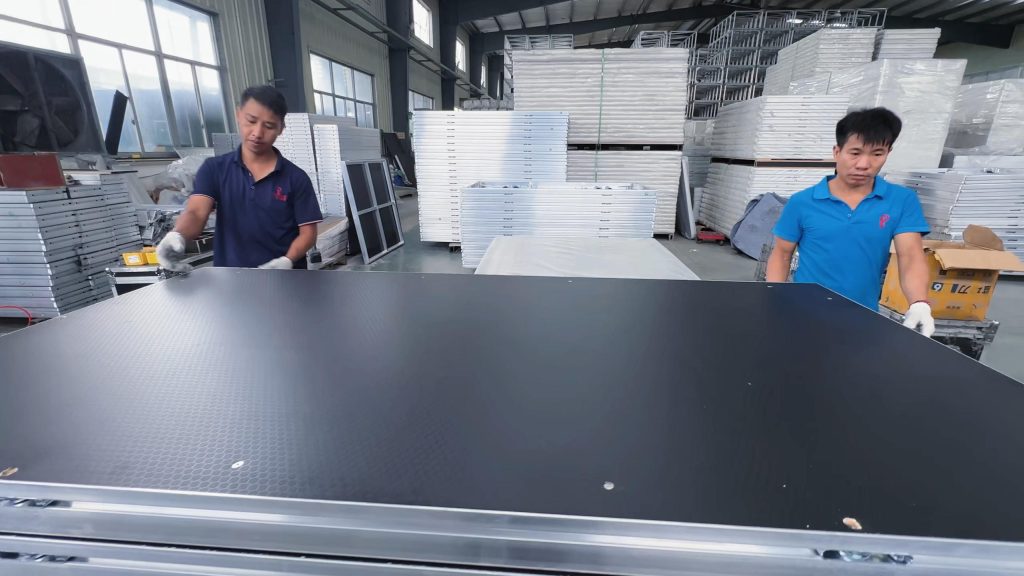
This article is based on real photos and a short factory video filmed in our indoor warehouse. In the video, two workers are packing stage boards while the camera shows the product details, aluminium alloy frame and related accessories.
https://www.youtube.com/watch?v=T4IKMRrYu-c
A Busy Indoor Warehouse for Stage Board Orders
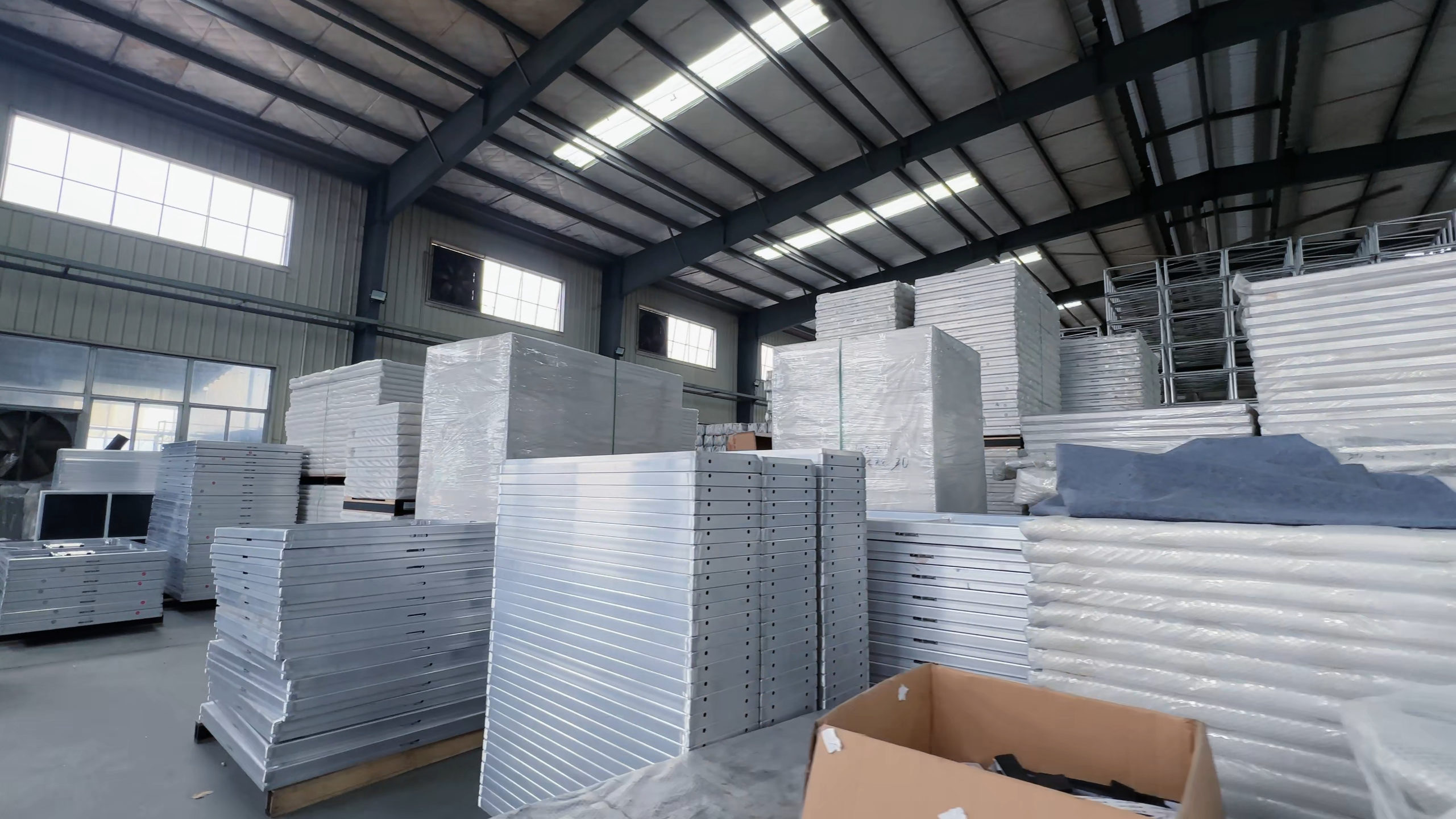
The first view is our indoor warehouse. Many finished stage boards have already been packed, while some semi-finished boards are still being prepared for packing.
The warehouse is full of stage boards stacked in different areas. This is a normal daily scene in our factory, especially during a busy order period. From the video, you can see that the surrounding storage area is mainly used for stage boards, packed panels and related stage components.
For customers, this kind of factory scene is useful because it shows real production and delivery capacity. Stage board orders are not handled as single loose pieces. They are usually produced, inspected, packed and stored in batches before shipment.
Stage Board Surface Options
Stage boards can be supplied with different surface options according to the project. Common choices include carpet panels, acrylic panels, glass panels and standard stage panels.
For most regular stage projects, the standard anti-slip panel is the most practical choice. It is designed for repeated stage use and is suitable for concerts, music festivals, events, exhibitions and temporary performance platforms.
Our standard stage board uses a 20 mm high-density professional plywood panel. The board is formed through hot pressing with solid wood layers, and the surface is treated with an anti-slip texture. The standard honeycomb-pattern surface provides good grip and can handle most concert and music festival applications.
This type of panel also offers practical performance for stage use, including wear resistance, moisture resistance, water resistance, oxidation resistance and flame-retardant properties. For event companies, these features are important because stage boards are often assembled, dismantled, transported and reused many times.
6061-T6 Aluminium Stage Frame
Around the stage board, the frame is made from 6061-T6 aluminium alloy. This material is widely used in professional stage systems because it is lightweight, strong and suitable for repeated assembly.
The aluminium frame improves the strength of the board edge and protects the panel during loading, unloading, installation and transport. It also helps the stage boards connect neatly with each other, so the finished platform looks clean and feels stable.
Compared with a basic panel-only structure, an aluminium-framed stage board is more suitable for professional event use. It offers better resistance to oxidation, rust and moisture, while also keeping the board easier to handle on site.
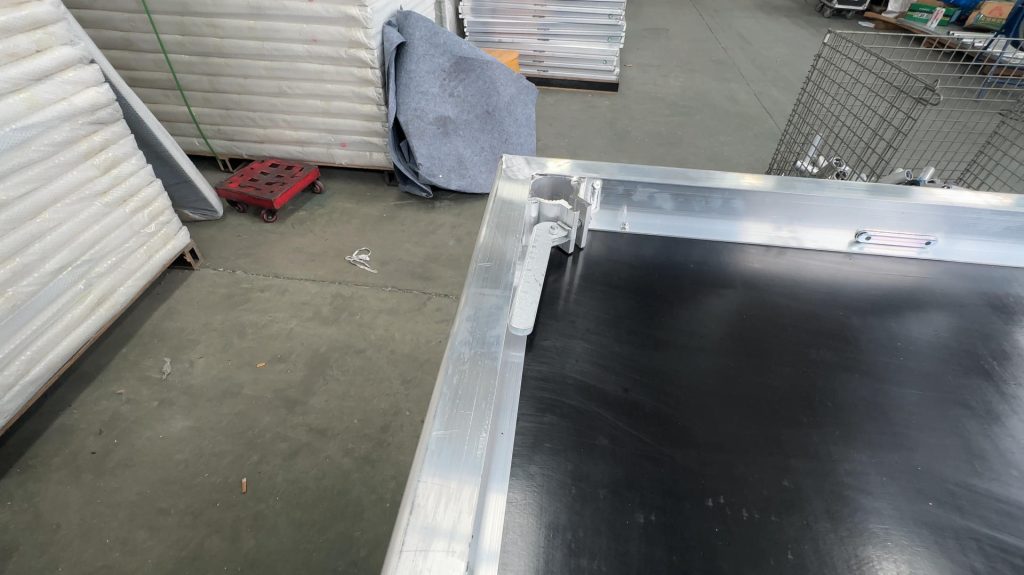
In the close-up photo, you can also see the stage post clamp area. The clamp is processed tightly so that the post can fit securely. The manual locking buckle makes installation and dismantling faster because workers do not need to fix the post with loose screws every time. This improves working efficiency, especially when many stage boards need to be assembled in a short time.
Adjustable Aluminium Stage Legs
The stage legs are also made from aluminium alloy. Depending on the project, they can be made as fixed-height legs or adjustable-height legs.
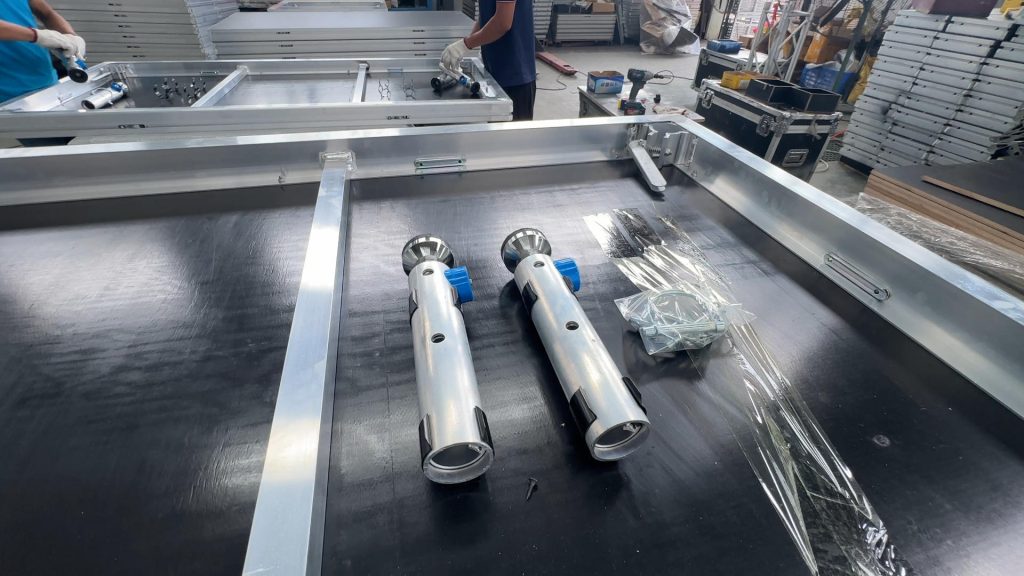
The legs shown in the photo are adjustable stage legs. They have two height positions. After the leg is extended to the required height, the pin can be inserted into the fixed hole to lock the position. This makes height adjustment simple, fast and stable.
At the bottom of the stage leg, the contact surface uses anti-slip rubber. This helps improve grip on the floor and increases the stability and safety of the stage system.
Adjustable legs are useful for customers who need different platform heights for different events. Fixed legs are also available when the required height is already confirmed and does not need to change frequently.
Side Locks and Reserved Lock Holes
The side lock system is one of the details that helps multiple stage boards form a tight and stable platform.
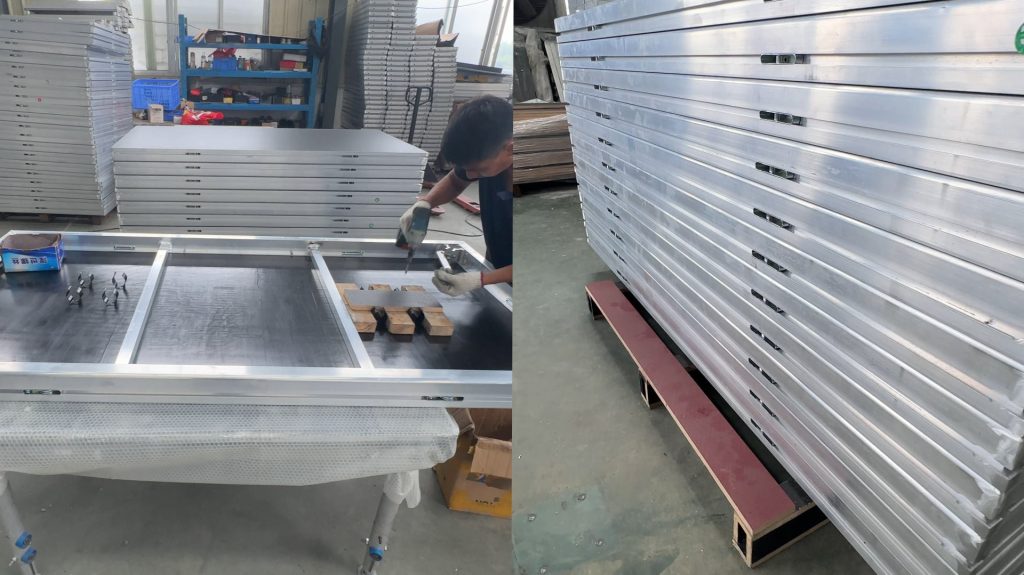
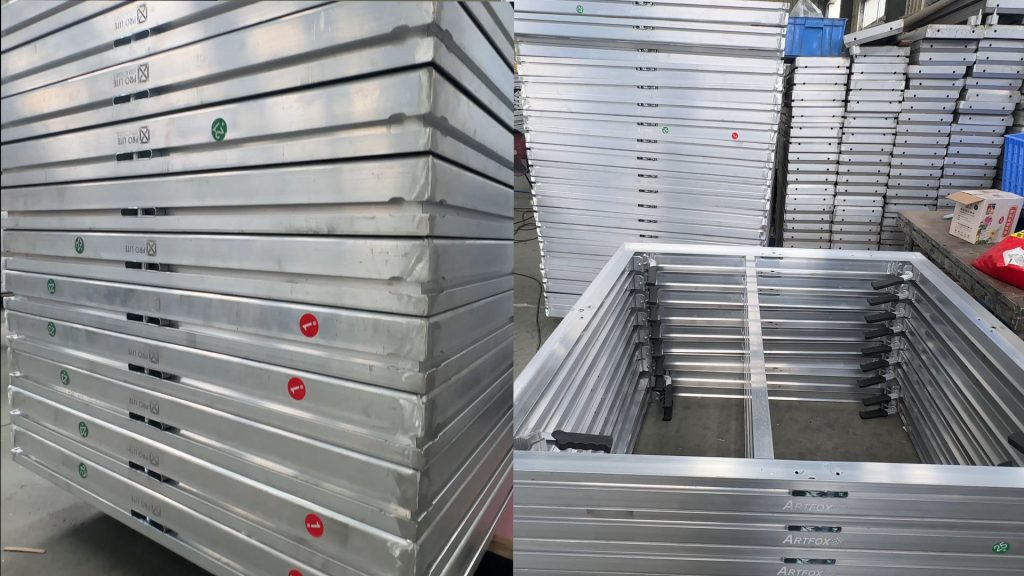
In the first image below, you can see the worker fixing the side lock to the stage board. One side of the board is equipped with the lock, while the opposite side is prepared with the reserved lock hole.
In the second image below, the stacked stage boards show the front and rear views of these side locks and lock holes more clearly.
When two stage boards need to be connected closely, the lock and lock hole fit together. The working principle is similar to a screw and nut: one part enters the other part and locks the two boards in position.
This design helps every board connect tightly with the next board. It not only improves the firmness of the whole platform, but also helps reduce gaps between stage boards after installation.
For large stages, this is especially important. A platform may use many boards, and every connection point affects the final flatness, stability and user experience.
Hardware Fixed to Each Stage Board Before Packing
Another important detail is the way workers prepare and fix accessories before packing.
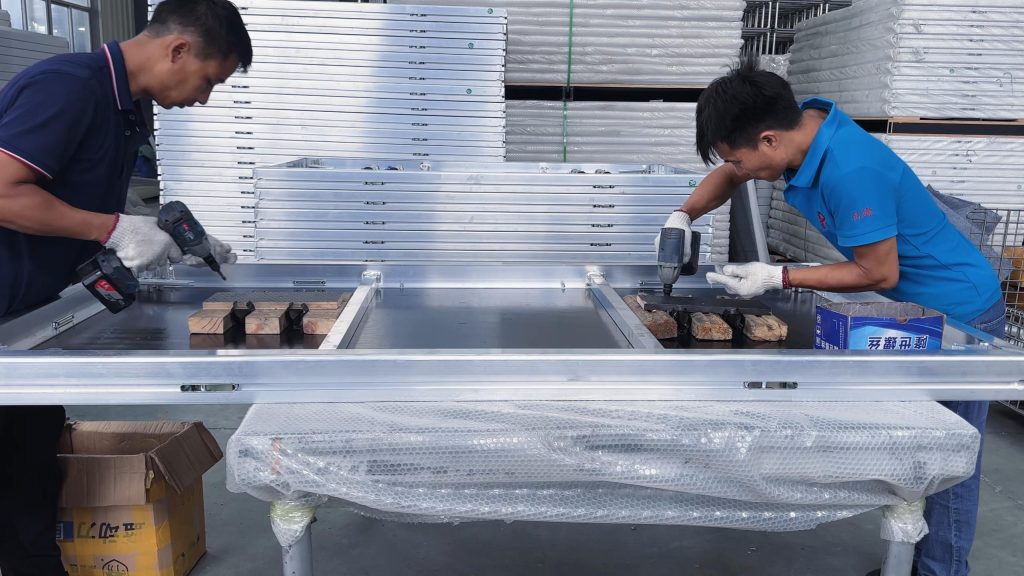
In the factory, every stage board is matched with its required accessories according to a clear process. The position of the stage leg fittings, the quantity of accessories and the required fixing parts are all arranged before packing.
This helps avoid missing parts after the goods arrive. Customers do not need to look for separate accessory packages during installation because the related parts are already fixed or prepared with the corresponding stage board.
In the image below, two workers are using electric screwdrivers to fix the hardware. This step may look small, but it saves valuable time during installation and dismantling. It also helps reduce packing volume because accessories are organized together with the board instead of being packed loosely.
For rental companies and event contractors, this kind of detail can make site work more efficient. When the installation team opens the package, the board and accessories are already matched, which reduces confusion and helps the team work faster.
Different Panels for Different Stage Applications
Different events need different types of stage panels. A wedding stage may use glass panels for a clean and elegant appearance. An automotive product launch may use acrylic panels for a modern display effect. An auditorium stage may use carpet panels for a softer and quieter surface.
Each type of stage has different loading and usage requirements. The stage board size, surface material, support structure and accessories should be selected according to the actual project.
For example, a 1000 x 2000 mm stage board specification can be designed to support up to 500 kg per square metre, depending on the complete stage configuration and support system. For projects with special loading requirements, the final design should be confirmed according to the stage size, height, use environment and load distribution.
Additional accessories can also be added when needed, such as guardrails and stairs. Guardrails are commonly used for speech platforms, elevated walkways, temporary access platforms and other areas where edge protection is required.
Suitable for Exhibitions, Launch Events, Concerts and Festivals
A professional modular stage system can be used for many types of projects.
For auto shows and vehicle display events, the stage system can be designed to carry heavier loads when the structure, board specification and support layout are properly selected. For concerts and music festivals, the same stage board system can be used for performance platforms, technical areas, side platforms and temporary event structures.
The key is not to use one standard answer for every project. Customers should provide the required stage size, height, load requirement, venue condition and application. Then the factory can recommend the suitable panel type, aluminium frame, support legs, braces, stairs and guardrails.
Tell us your project requirements, and our factory can customize the stage system according to the actual use.
Quality, Export Experience and Factory Visits
Our stage products are produced for international customers and have been exported to more than 30 countries. With international market experience, stable product quality and practical factory production capacity, we can support both small indoor events and large outdoor stage projects.
From small activity platforms to large music festival stages, a reliable stage floor system must stand up to repeated handling, assembly and high-intensity use. That is why material selection, frame structure, locking details, support accessories and packing quality all matter.
We welcome global suppliers, event contractors and returning customers to visit our factory. Seeing the production workshop, warehouse, stage board details and packing process in person is often the best way to understand the product quality.
If you are planning a modular stage, portable stage, exhibition platform, concert stage, stage platform, temporary walkway or event flooring project, send us your required dimensions, height, load requirement and usage environment. Our team will help recommend a suitable stage board system for your project.