
Large Event Tent Installation Process | Aluminum Structure & Fabric Roof Setup
Returning Client Visits On-Site Installation of Roof Truss System
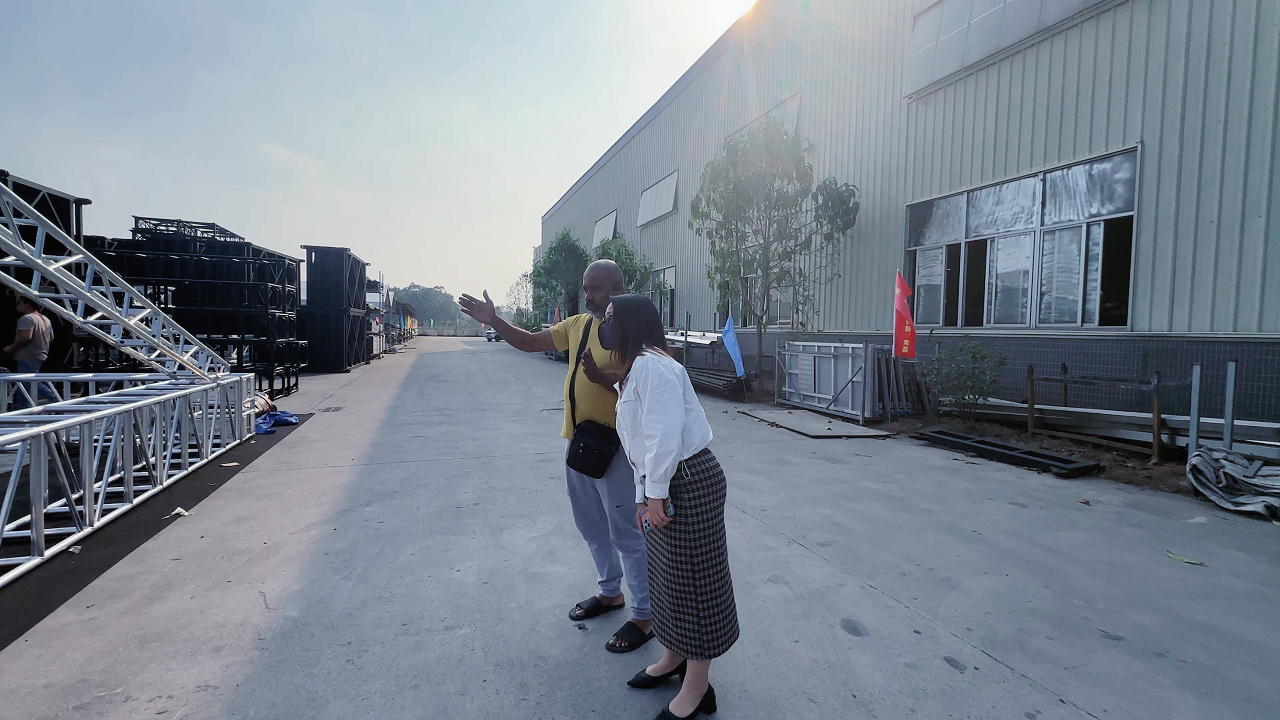
Today was another on-site installation day with one of our returning clients visiting to observe the assembly process together with our technical team.
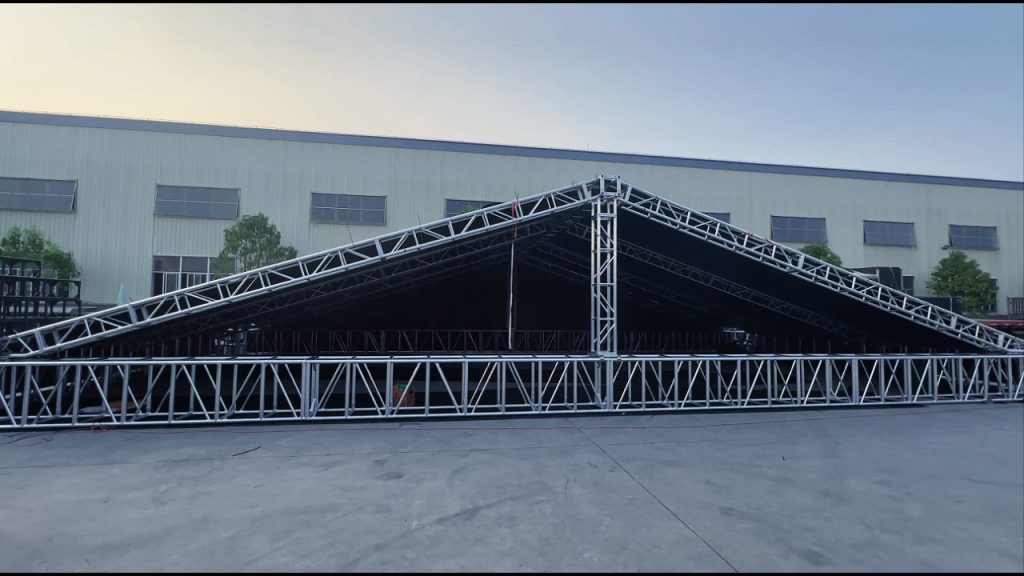
The product being installed was an aluminum roof truss system designed for outdoor event coverage, combined with a 450g black PVC roof fabric. These temporary event structures are widely used for concerts, festivals, exhibitions, and outdoor commercial events where weather protection and structural stability are essential.
In this article, we will mainly focus on the installation process and on-site assembly workflow rather than introducing every truss component and accessory in detail.
The overall installation procedure is actually straightforward when handled by an experienced technical crew. The client had previously purchased our aluminum truss systems and recently expanded the order to include the roof truss structure. This visit was mainly arranged so the client could observe the complete setup process in person and better understand how the structure is assembled step by step.
During the installation, our technicians demonstrated the complete workflow on site, including frame positioning, structural connections, and roof fabric installation. Whenever questions came up, the client was also able to communicate directly with our sales manager and technical team for immediate explanations and practical guidance.
PVC Roof Fabric Installation on Aluminum Roof Truss System
Once the aluminum roof truss structure was fully assembled, the next step was positioning and installing the PVC roof fabric according to the exact length and width of the roof system.
Before pulling the fabric into place, our technical team carefully aligned the 450g black PVC tent cover with the roof truss frame to ensure the installation direction and tension points matched correctly. Proper alignment is extremely important during large event tent installation, especially for temporary outdoor structures exposed to wind and weather conditions.
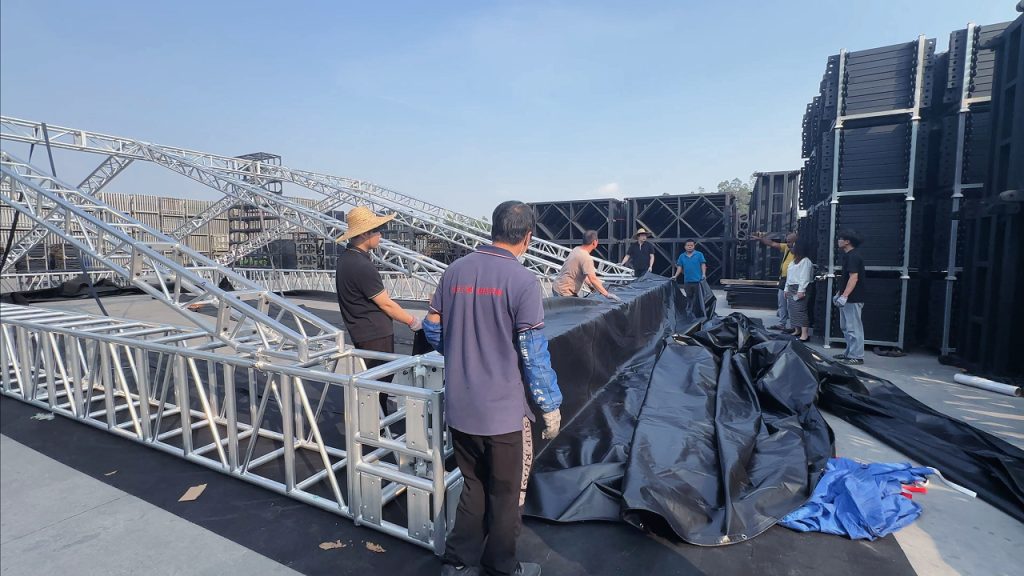
The roof fabric installation process requires coordinated teamwork rather than brute force. One person alone cannot pull the PVC fabric from the opposite side, as uneven force distribution may damage the material or cause installation difficulties.
Instead, three to four technicians stand in a straight line along the side of the structure, applying balanced pulling force together while slowly guiding the roof fabric across the aluminum truss system. This method allows the heavy-duty PVC tent fabric to move smoothly and evenly over the roof frame without excessive stress on specific connection points.
Because the 450g black PVC material is relatively heavy and designed for professional outdoor event use, controlled movement and even tension distribution are essential during installation. Pulling too aggressively from one side may not only make the fabric difficult to move, but could also increase the risk of fabric tearing or structural misalignment.
This step may appear simple from the outside, but in professional event structure installation, proper roof fabric handling plays an important role in weather resistance, water drainage performance, and long-term structural stability.
Midway Stage of PVC Roof Fabric Installation
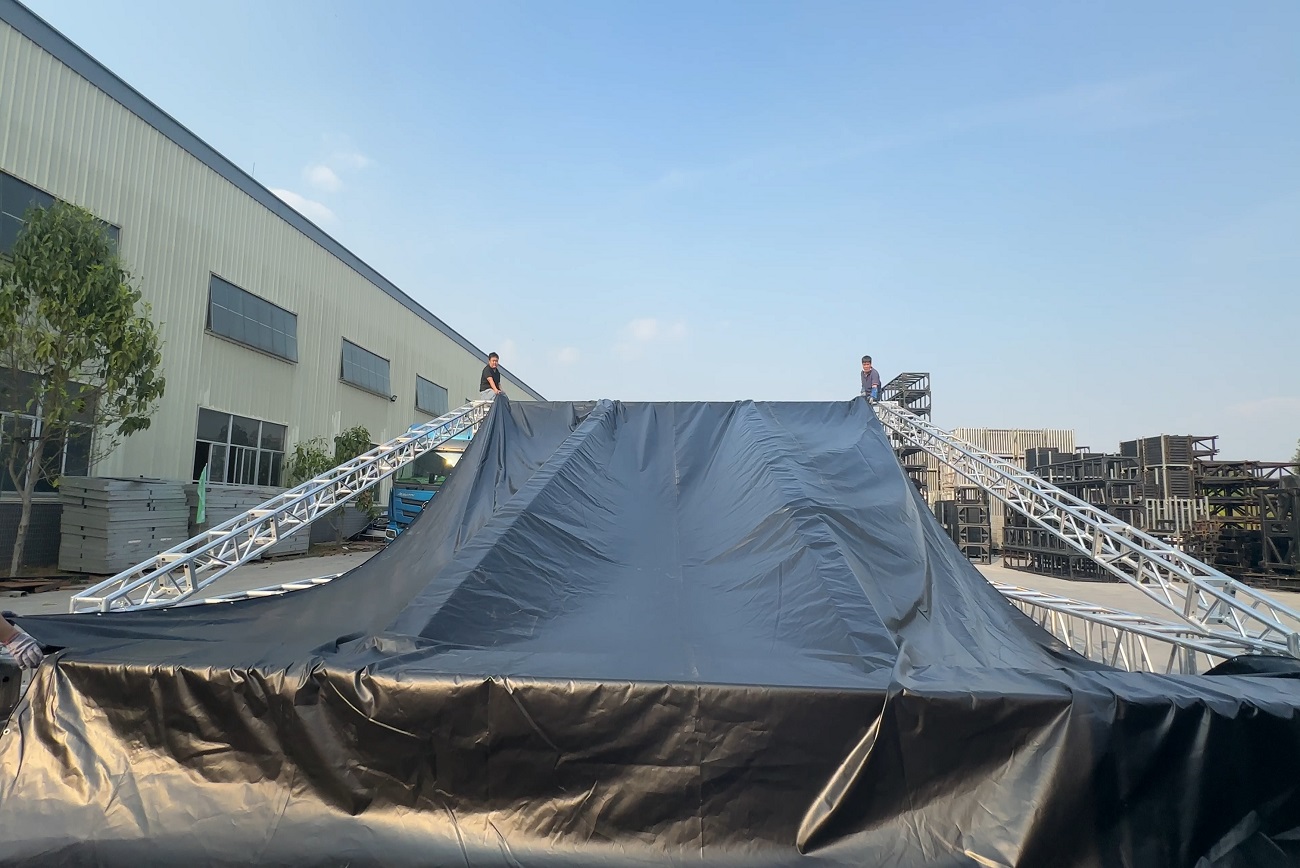
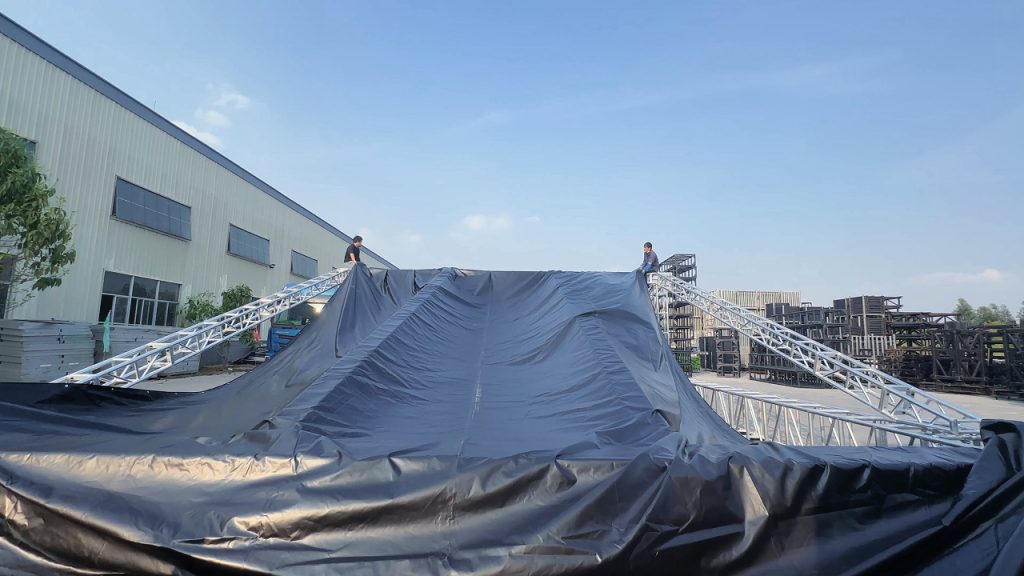
When the roof fabric installation reaches the halfway stage, additional technicians are required on both sides of the roof structure to assist with guiding and positioning the PVC cover. At this point, the fabric is gradually passed across the top of the aluminum roof truss system from one side to the other, almost like a controlled handover along the entire roof line.
This process must never be done with force or sudden pulling. Instead, the PVC roof fabric should be carefully advanced step by step, ensuring smooth movement across the structure without causing stress on the material or misalignment of the frame.
During installation, there is a key reference point at the center of the roof structure. This midpoint allows the installation team to clearly identify where the fabric is positioned and how evenly it has been distributed on both sides. Based on this reference, technicians can accurately judge whether the roof fabric has reached a balanced spread across the aluminum truss system.
Structural Fixing and Tension Control of Roof Fabric System
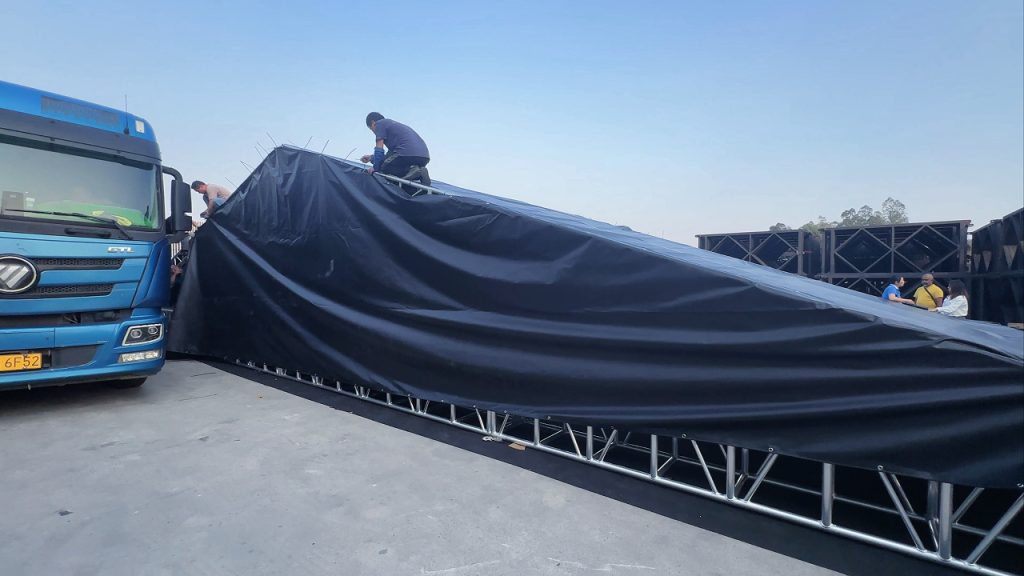
Once the length direction is properly positioned, the next step is to adjust and tension the width of the PVC fabric. This involves pulling the material outward on both sides and securing it onto the outermost pipes of the aluminum roof truss structure.
For this on-site temporary installation, cable ties are used as the fastening method. ⚠️ However, it is important to note that for standard commercial events such as concerts, exhibitions, or festival setups, professional-grade fastening ropes or heavy-duty cable ties should be used to ensure higher safety performance and structural reliability.
The fixing points are typically installed along the outermost truss pipes, with spacing of approximately 30–40 cm between each connection point. This ensures even tension distribution across the entire roof surface.
Each aluminum roof truss system and PVC roof fabric cover is custom-designed and manufactured according to precise length and width requirements. This allows the roof structure and fabric to match perfectly during installation, ensuring a tight, stable, and professional finish for outdoor event applications.
PVC Side Wall Installation on Aluminum Roof Truss System
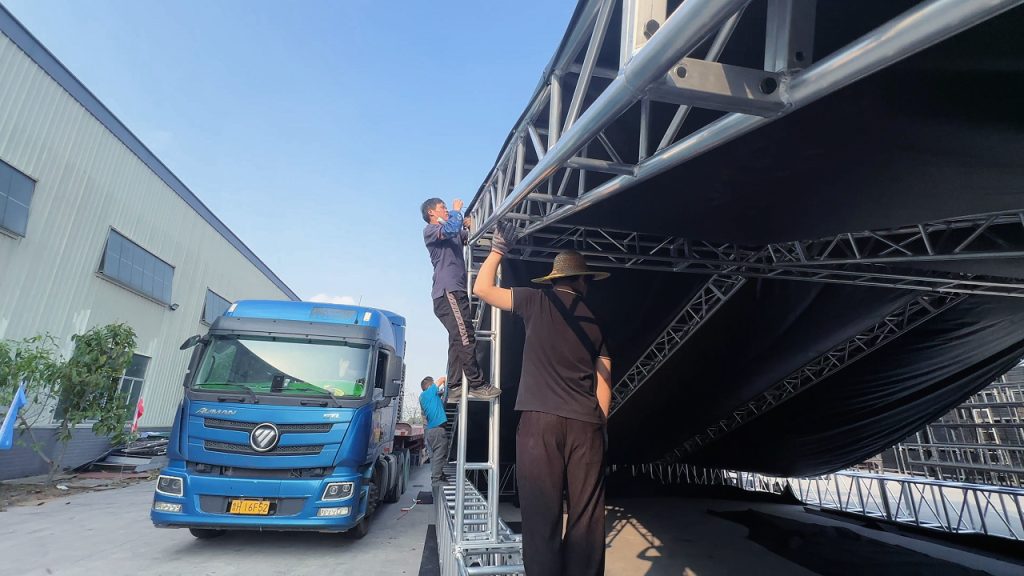
After the roof section of the PVC fabric has been securely fixed onto the top of the aluminum roof truss structure, the next step is to continue with the side wall fabric installation.
Compared to the roof installation process, this stage is relatively more straightforward. The PVC side curtain fabric is first fully unfolded and then carefully positioned according to the pre-designed frame layout of the temporary event structure.
Once aligned, the fabric is gradually placed along the side sections of the aluminum truss system and secured at designated fixing points. This ensures that the side enclosure follows the structural lines accurately without distortion or uneven tension.
Although the process appears simple, proper alignment is still important to maintain a clean overall appearance and ensure the stability of the full event tent system. Correct positioning of the side PVC fabric also helps complete the enclosure of the structure, improving wind resistance and overall structural integrity for outdoor use.
Waterproof Connection System for PVC Roof Fabric Joints
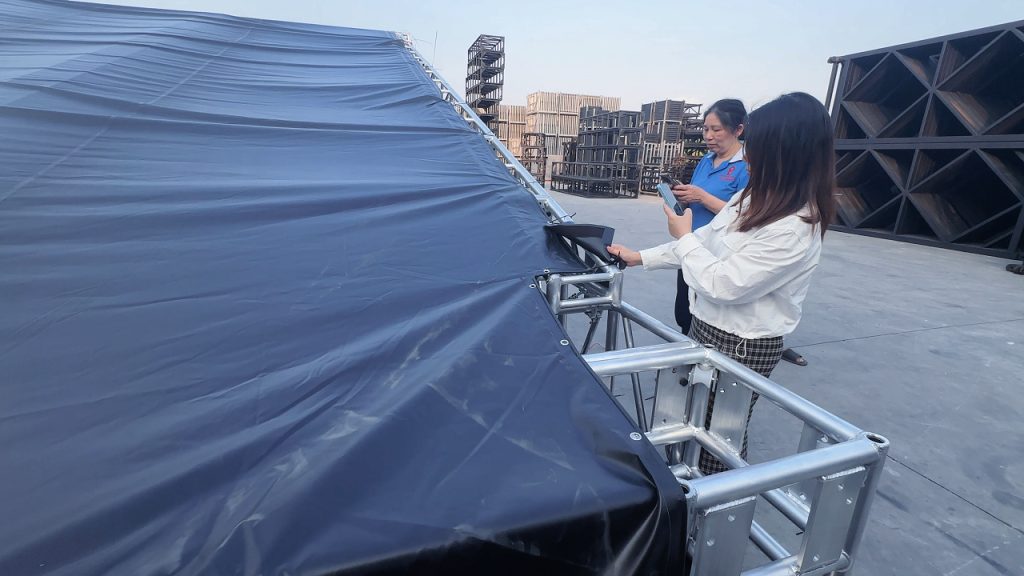
After the main structure and roof fabric installation were completed, our technical team also provided a detailed on-site explanation to the client regarding the auxiliary fixing accessories used in the system, including the truss fabric securing straps and the waterproof Velcro overlap flap designed for roof connections.
This waterproof flap is not a simple “fixing strip” as it may appear at first glance. It is a specially engineered component developed for multi-panel PVC roof fabric connection systems in large-scale aluminum roof truss structures. Its main function is to cover and protect the fabric joint lines where two or more roof sections are joined together.
By overlapping the connection seams, the waterproof flap effectively blocks rainwater penetration. Instead of allowing water to accumulate or seep through the joint gaps, the design guides water flow along the surface of the flap, ensuring it naturally drains away from the connection area.
This type of sealing system is widely used in large outdoor event structures, such as stage installations, music festivals, and wedding tent setups, where multiple roof fabric sections need to be combined into a unified waterproof surface. Combined with truss fabric fixing straps and Velcro-based connection systems, it significantly improves the overall weather resistance and structural reliability of the temporary event tent system.
Final Inspection and Interior View of Roof Fabric Installation
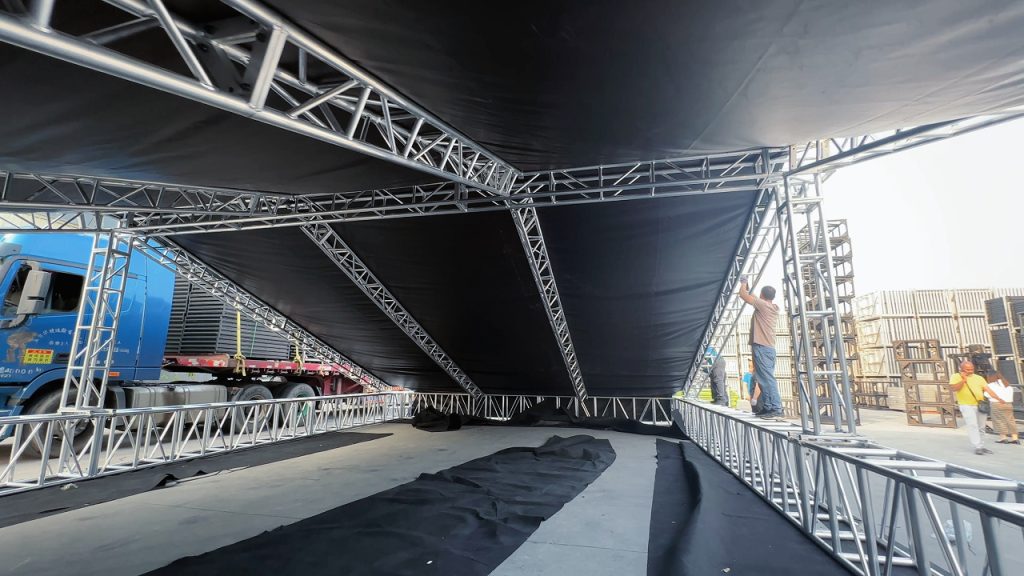
Now we take a closer look inside the structure after the PVC roof fabric installation has been completed.
From the interior view of the aluminum roof truss system, the roof fabric is now evenly tensioned across the entire span. The PVC cover sits flat and smooth, with no visible wrinkles or sagging areas. This indicates that the installation has reached an ideal tensioning condition.
At this stage, the roof fabric is not only visually neat, but also structurally optimized. Proper tension distribution across the aluminum roof truss ensures that wind load is evenly transferred through the frame, improving overall stability of the temporary event structure.
Another key advantage of this tight and uniform installation is water management. When the PVC roof fabric is correctly tensioned, rainwater will not accumulate on the surface. Instead, it naturally flows along the slope of the roof, preventing ponding or water pockets that could otherwise affect safety and structural performance.
This is the ideal installation condition for professional aluminum roof truss systems used in outdoor events, where both visual appearance and structural reliability are equally important.
Conclusion
This on-site project was not only about the installation of an aluminum roof truss system and PVC roof fabric structure, but also a complete process of technical communication, solution discussion, and practical demonstration with our client.
From the early stage of product introduction and structural selection, to on-site inspection and installation observation, our team worked closely with the client to ensure every detail was clearly understood. During the process, we also discussed different structural configurations and installation methods based on real project requirements, providing practical solutions for their future applications.
This visit also served as a valuable face-to-face business meeting, allowing the client to directly observe product quality, installation workflow, and structural performance in a real working environment. It strengthened mutual understanding and built a stronger foundation for future cooperation.
At ENO Stage, we do not only deliver stage structures and event equipment. We focus on helping clients solve real project challenges through professional support, reliable products, and on-site technical communication. Whether it is product selection, structural planning, or installation guidance, our goal is always to provide practical and efficient solutions for every project.
We look forward to more long-term cooperation with global clients in future projects.
We also warmly welcome clients and business partners from all over the world to visit our site for on-site inspection, product demonstration, and business discussions. Our team is always ready to receive you and provide professional support for project consultation, cooperation opportunities, and customized solutions tailored to different project requirements.
In addition, we offer full customization services for aluminum roof truss systems and PVC roof fabric structures to meet specific event and engineering needs. You are also welcome to send us inquiries directly through the inquiry form or email button located at the bottom right corner of our website. Our team will respond promptly and assist you with detailed project support.